

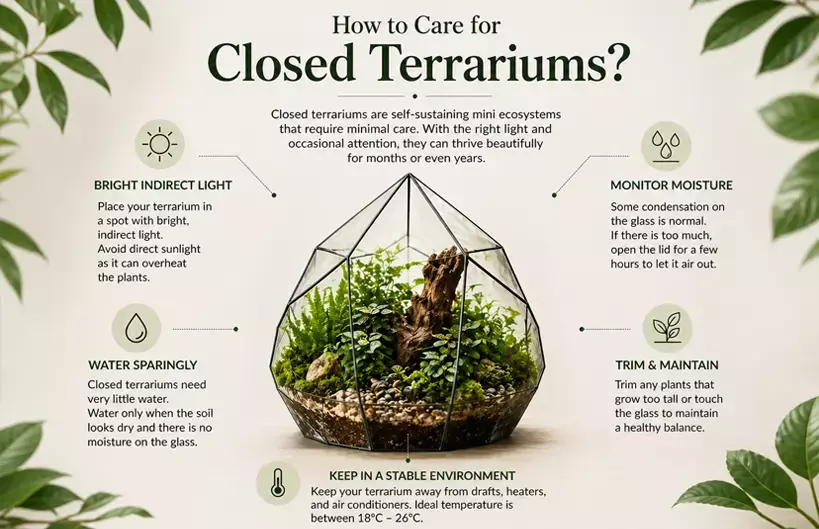
Light – Bright but Indirect
Closed terrariums need bright, indirect sunlight. Place your terrarium near a window where it receives filtered light. Avoid direct sunlight, as it can overheat the glass container and damage the plants. If you notice leaves turning yellow or the terrarium drying too quickly, it may be getting too much light.
Watering – Less is More
Closed terrariums require very little watering because the moisture inside is naturally recycled. If you see light condensation on the glass, the moisture level is perfect. If the glass is always foggy, there is too much water and you should open the lid for a few hours. If there is no condensation, you can add a small amount of water. In most cases, watering once every 2 to 4 weeks is enough.
Keep the Lid Closed
A closed terrarium works as a self-contained environment, so the lid should remain closed most of the time. You can open it occasionally to reduce excess humidity, trim plants, or adjust moisture levels.
Pruning and Maintenance
Temperature and Placement
Watch for Mold or Pests
Sometimes excess moisture can cause mold or small pests. If this happens, open the lid for ventilation and remove any affected material. Reducing moisture usually solves the problem quickly.
Best Plants for Closed Terrariums
Closed terrariums are best suited for humidity-loving plants such as moss, ferns, and fittonia. Avoid using succulents or cacti, as they prefer dry conditions.
Final Tips
You can edit text on your website by double clicking on a text box on your website. Alternatively, when you select a text box a settings menu will appear. your website by double clicking on a text box on your website. Alternatively, when you select a text box